
First impeachment

In August 2019, a whistleblower filed a complaint with the Inspector General of the Intelligence Community about a July 25 phone call between Trump and Ukrainian president Volodymyr Zelenskyy, during which Trump had pressured Zelenskyy to investigate CrowdStrike and Democratic presidential candidate Biden and his son Hunter.
The whistleblower said that the White House had attempted to cover up the incident and that the call was part of a wider campaign by the Trump administration and Trump attorney Rudy Giuliani that may have included withholding financial aid from Ukraine in July 2019 and canceling Pence’s May 2019 Ukraine trip.
House Speaker Nancy Pelosi initiated a formal impeachment inquiry on September 24. Trump then confirmed that he withheld military aid from Ukraine, offering contradictory reasons for the decision. On September 25, his administration released a memorandum of the phone call which confirmed that, after Zelenskyy mentioned purchasing American anti-tank missiles, Trump asked him to discuss investigating Biden and his son with Giuliani and Barr.
The testimony of multiple administration officials and former officials confirmed that this was part of a broader effort to further Trump’s personal interests by giving him an advantage in the upcoming presidential election. In October, William B. Taylor Jr., the chargé d’affaires for Ukraine, testified before congressional committees that soon after arriving in Ukraine in June 2019, he found that Zelenskyy was being subjected to pressure directed by Trump and led by Giuliani.
According to Taylor and others, the goal was to coerce Zelenskyy into making a public commitment to investigate the company that employed Hunter Biden, as well as rumors about Ukrainian involvement in the 2016 U.S. presidential election. He said it was made clear that until Zelenskyy made such an announcement, the administration would not release scheduled military aid for Ukraine and not invite Zelenskyy to the White House.
On December 13, the House Judiciary Committee voted along party lines to pass two articles of impeachment: one for abuse of power and one for obstruction of Congress. After debate, the House of Representatives impeached Trump on both articles on December 18.

During the trial in January 2020, the House impeachment managers cited evidence to support charges of abuse of power and obstruction of Congress and asserted that Trump’s actions were exactly what the founding fathers had in mind when they created the impeachment process.
Trump’s lawyers did not deny the facts as presented in the charges, but said that he had not broken any laws or obstructed Congress. They argued that the impeachment was “constitutionally and legally invalid” because he was not charged with a crime and that abuse of power is not an impeachable offense.
On January 31, the Senate voted against allowing subpoenas for witnesses or documents. The impeachment trial was the first in U.S. history without witness testimony.
Trump was acquitted of both charges by the Republican majority. Senator Mitt Romney was the only Republican who voted to convict him on one charge, the abuse of power. Following his acquittal, he fired impeachment witnesses and other political appointees and career officials he deemed insufficiently loyal.
Second impeachment
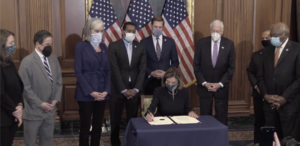
On January 11, 2021, an article of impeachment charging Trump with incitement of insurrection against the U.S. government was introduced to the House. The House voted 232–197 to impeach him on January 13, making him the first U.S. president to be impeached twice. Ten Republicans voted for the impeachment—the most members of a party ever to vote to impeach a president of their own party.
On February 13, following a five-day Senate trial, Trump was acquitted when the Senate vote fell ten votes short of the two-thirds majority required to convict; seven Republicans joined every Democrat in voting to convict, the most bipartisan support in any Senate impeachment trial of a president or former president. Most Republicans voted to acquit him, although some held him responsible but felt the Senate did not have jurisdiction over former presidents (he had left office on January 20; the Senate voted 56–44 that the trial was constitutional).