
Political practice and rhetoric
Beginning with his 2016 campaign, Trump’s politics and rhetoric led to the creation of a political movement known as Trumpism. Professor Mary Stuckey identified Trump’s rhetoric as using vitriol: “demeaning language, false equivalency, and exclusion”. Professor Gary Jacobson found Trump used fearmongering about immigrants and minorities that other researchers found were essential to his support. His political base has been compared to a cult of personality.
Trump’s political positions have been described as right-wing populist. Politico described them as “eclectic, improvisational and often contradictory”. Trump helped bring far-right fringe ideas and organizations into the mainstream. The alt-right movement coalesced around and supported Trump’s candidacy, due in part to its opposition to multiculturalism and immigration. Trump has a strong appeal to evangelical Christian voters. He appeals to Christian nationalists, and his rallies take on the symbols, rhetoric and agenda of Christian nationalism.
Link to hate crimes
Research suggests Trump’s rhetoric is associated with an increased incidence of hate crimes. During his 2016 campaign, he urged or praised physical attacks against protesters or reporters. Numerous defendants investigated or prosecuted for violent acts and hate crimes, including participants in the storming of the U.S. Capitol, cited Trump’s rhetoric in arguing that they were not culpable or should receive leniency. A nationwide review by ABC News in May 2020 identified at least 54 criminal cases from August 2015 to April 2020 in which Trump was invoked in direct connection with violence or threats of violence mostly by white men and primarily against minorities.
Truthfulness

As a candidate and as president, Trump frequently made false statements in public remarks to an extent unprecedented in American politics. His falsehoods are a distinctive part of his political identity and have been described as firehosing.
Trump’s false and misleading statements were documented by fact-checkers, including at The Washington Post, which tallied 30,573 false or misleading statements made by Trump during his first presidency, increasing in frequency over time.
Some of Trump’s falsehoods were inconsequential, such as his repeated claim of the “biggest inaugural crowd ever”. Others had more far-reaching effects, such as his promotion of antimalarial drugs as an unproven treatment for COVID-19, causing a U.S. shortage of these drugs and panic-buying in Africa and South Asia. Other misinformation, such as misattributing a rise in crime in England and Wales to the “spread of radical Islamic terror”, served Trump’s domestic political purposes.
His attacks on mail-in ballots and other election practices weakened public faith in the integrity of the 2020 presidential election, while his disinformation about the pandemic delayed and weakened the national response to it. Trump habitually does not apologize for his falsehoods.
Until 2018, the media rarely referred to Trump’s falsehoods as lies, including when he repeated demonstrably false statements.
Conspiracy theories
Before and throughout his presidency, Trump promoted numerous conspiracy theories, including Obama birtherism, the Clinton body count conspiracy theory, the conspiracy theory movement QAnon, the Global warming hoax theory, Trump Tower wiretapping allegations, that Osama bin Laden was alive and Obama and Biden had members of Navy SEAL Team 6 killed, and alleged Ukrainian interference in U.S. elections. In at least two instances, Trump clarified to press that he believed the conspiracy theory in question.
During and since the 2020 presidential election, Trump promoted various conspiracy theories for his defeat.
Social media
Trump’s social media presence attracted worldwide attention after he joined Twitter in 2009. He tweeted frequently during his 2016 campaign and as president until Twitter banned him after the January 6 attack. Trump often used Twitter to communicate directly with the public and sideline the press. In June 2017, the White House press secretary said that Trump’s tweets were official presidential statements.
After years of criticism for allowing Trump to post misinformation and falsehoods, Twitter began to tag some of his tweets with fact-checks in May 2020. In response, Trump tweeted that social media platforms “totally silence” conservatives and that he would “strongly regulate, or close them down”.
In the days after the storming of the Capitol, Trump was banned from Facebook, Instagram, Twitter and other platforms. The loss of his social media presence diminished his ability to shape events and prompted a dramatic decrease in the volume of misinformation shared on Twitter. In February 2022, he launched social media platform Truth Social where he only attracted a fraction of his Twitter following.
Elon Musk, after acquiring Twitter, reinstated Trump’s Twitter account in November 2022. Meta Platforms’ two-year ban lapsed in January 2023, allowing Trump to return to Facebook and Instagram, although in 2024, Trump continued to call the company an “enemy of the people”.
Relationship with the press
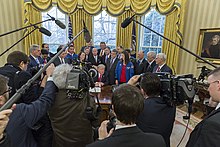
Trump sought media attention throughout his career, sustaining a “love-hate” relationship with the press. In the 2016 campaign, Trump benefited from a record amount of free media coverage, elevating his standing in the Republican primaries. The New York Times writer Amy Chozick wrote in 2018 that Trump’s media dominance enthralled the public and created “must-see TV”.
As a candidate and as president, Trump frequently accused the press of bias, calling it the “fake news media” and “the enemy of the people”. In 2018, journalist Lesley Stahl said that Trump had privately told her that he intentionally discredited the media “so when you write negative stories about me no one will believe you”.
As president, Trump mused about revoking the press credentials of journalists he viewed as critical. His administration moved to revoke the press passes of two White House reporters, which were restored by the courts.[829] The Trump White House held about a hundred formal press briefings in 2017, declining by half during 2018 and to two in 2019.
Trump also deployed the legal system to intimidate the press. The Trump campaign sued The New York Times, The Washington Post, and CNN for defamation in opinion pieces about Russian election interference. All the suits were dismissed. By 2024, Trump repeatedly voiced support for outlawing political dissent and criticism he considers misleading or challenges his claims to power, and that media companies should be investigated and prosecuted for treason for displaying “bad stories” about him and possibly lose their broadcast licenses if they refuse to name confidential sources.