
Early life, education, family
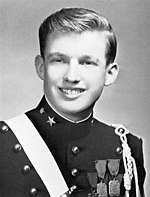
Trump was born on June 14, 1946, at Jamaica Hospital in Queens, New York City, the fourth child of Fred Trump and Mary Anne MacLeod Trump. He is of German and Scottish descent. He grew up with older siblings Maryanne, Fred Jr., and Elizabeth and younger brother Robert in the wealthy Jamaica Estates neighborhood of Queens. He attended the private Kew-Forest School through seventh grade and New York Military Academy, a private boarding school, from eighth through twelfth grade.
In 1964, Trump enrolled at Fordham University. Two years later, he transferred to the Wharton School of the University of Pennsylvania, graduating in May 1968 with a Bachelor of Science in economics. In 2015, he threatened his high school, colleges, and the College Board with legal action if they released his academic records.
In 1977, Trump married Czech model Ivana Zelníčková. They had three children: Donald Jr. (born 1977), Ivanka (1981), and Eric (1984). The couple divorced in 1990, following his affair with actress Marla Maples.[11] He and Maples married in 1993 and divorced in 1999. They have one daughter, Tiffany (born 1993), who Maples raised in California. In 2005, he married Slovenian model Melania Knauss. They have one son, Barron (born 2006).
Personal life
Health habits
Trump says he has never drunk alcohol, smoked cigarettes, or used drugs. He sleeps about four or five hours a night. He has called golfing his “primary form of exercise”, but usually does not walk the course. He considers exercise a waste of energy because he believes the body is “like a battery, with a finite amount of energy”, which is depleted by exercise.
In 2015, his campaign released a letter from his longtime personal physician, Harold Bornstein, stating that he would “be the healthiest individual ever elected to the presidency”. In 2018, Bornstein said Trump had dictated the contents of the letter and that three of Trump’s agents had seized his medical records in a February 2017 raid on the doctor’s office.
Wealth
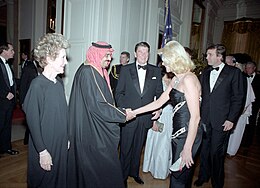
In 1982, Trump made the initial Forbes list of wealthy people for holding a share of his family’s estimated $200 million net worth (equivalent to $631 million in 2023).
His losses in the 1980s dropped him from the list between 1990 and 1995. After filing the mandatory financial disclosure report with the FEC in July 2015, he announced a net worth of about $10 billion. Records released by the FEC showed at least $1.4 billion in assets and $265 million in liabilities. Forbes estimated his net worth dropped by $1.4 billion between 2015 and 2018. In their 2024 billionaires ranking, his net worth was estimated to be $2.3 billion (1,438th in the world).
In 2018, journalist Jonathan Greenberg reported that Trump had called him in 1984 pretending to be a fictional Trump Organization official named “John Barron”. Greenberg said that, to get a higher ranking on the Forbes 400 list of wealthy Americans, Trump, speaking as “Barron”, falsely asserted that Donald Trump owned more than 90 percent of his father’s business. Greenberg also wrote that Forbes had vastly overestimated Trump’s wealth and wrongly included him on the 1982, 1983, and 1984 rankings.
Trump has often said he began his career with “a small loan of a million dollars” from his father and that he had to pay it back with interest. He was a millionaire by age eight, borrowed at least $60 million from his father, largely failed to repay those loans, and received another $413 million (2018 dollars adjusted for inflation) from his father’s company. In 2018, he and his family were reported to have committed tax fraud, and the New York State Department of Taxation and Finance started an investigation.
His investments underperformed the stock and New York property markets.[33][34] Forbes estimated in October 2018 that his net worth declined from $4.5 billion in 2015 to $3.1 billion in 2017 and his product-licensing income from $23 million to $3 million.
Trump’s tax returns from 1985 to 1994 show net losses totaling $1.17 billion. The losses were higher than those of almost every other American taxpayer. The losses in 1990 and 1991, more than $250 million each year, were more than double those of the nearest taxpayers. In 1995, his reported losses were $915.7 million (equivalent to $1.83 billion in 2023).
In 2020, The New York Times obtained Trump’s tax information extending over two decades. Its reporters found that he reported losses of hundreds of millions of dollars. Since 2010 he had also failed to pay back $287 million in loans. During the 15 years prior to 2020, using tax credits for business losses, he paid no income taxes in 10 of those years and $750 each in 2016 and 2017. He balanced his businesses’ losses by selling and borrowing against assets, including a $100 million mortgage on Trump Tower (refinanced in 2022) and the liquidation of over $200 million in stocks and bonds. He personally guaranteed $421 million in debt, most of which is due by 2024.
As of October 2021, Trump had over $1.3 billion in debts, much of which was secured by his assets. In 2020, he owed $640 million to banks and trust organizations, including Bank of China, Deutsche Bank, and UBS, and approximately $450 million to unknown creditors. The value of his assets exceeds his debt.
Racial views
Many of Trump’s comments and actions have been described as racist. In national polling, about half of respondents said that he is racist; a greater proportion believed that he emboldened racists. Several studies and surveys found that racist attitudes fueled his political ascent and were more important than economic factors in determining the allegiance of Trump voters. Racist and Islamophobic attitudes are a powerful indicator of support for Trump.
In 1975, Trump settled a 1973 Department of Justice lawsuit that alleged housing discrimination against black renters.[ He has also been accused of racism for insisting a group of black and Latino teenagers were guilty of raping a white woman in the 1989 Central Park jogger case, even after they were exonerated by DNA evidence in 2002. As of 2019, he maintained this position.
In 2011, when he was reportedly considering a presidential run, Trump became the leading proponent of the racist “birther” conspiracy theory, alleging that Barack Obama, the first black U.S. president, was not born in the U.S. In April, he claimed credit for pressuring the White House to publish the “long-form” birth certificate, which he considered fraudulent, and later said this made him “very popular”. In September 2016, amid pressure, he acknowledged that Obama was born in the U.S. In 2017, he reportedly expressed birther views privately.
According to an analysis in Political Science Quarterly, Trump made “explicitly racist appeals to whites” during his 2016 presidential campaign. In particular, his campaign launch speech drew criticism for claiming Mexican immigrants were “bringing drugs, they’re bringing crime, they’re rapists”; in response, NBC fired him from Celebrity Apprentice. His later comments about a Mexican-American judge presiding over a civil suit regarding Trump University were also criticized as racist.
Trump’s comments on the 2017 Unite the Right rally, condemning “this egregious display of hatred, bigotry and violence on many sides” and stating that there were “very fine people on both sides”, were criticized as implying a moral equivalence between the white supremacist demonstrators and the counter-protesters.
In a January 2018 discussion of immigration legislation, Trump reportedly referred to El Salvador, Haiti, Honduras, and African nations as “shithole countries”. His remarks were condemned as racist.
In July 2019, Trump tweeted that four Democratic congresswomen—all from minorities, three of whom are native-born Americans—should “go back” to the countries they “came from”. Two days later the House of Representatives voted 240–187, mostly along party lines, to condemn his “racist comments”. White nationalist publications and social media praised his remarks, which continued over the following days. He continued to make similar remarks during his 2020 campaign.
Misogyny and allegations of sexual misconduct
Trump has a history of belittling women when speaking to the media and on social media. He made lewd comments, disparaged women’s physical appearances, and referred to them using derogatory epithets. At least 25 women publicly accused him of rape, kissing without consent, groping, looking under women’s skirts, and walking in on naked teenage pageant contestants. He has denied the allegations.
In October 2016, two days before the second presidential debate, a 2005 “hot mic” recording surfaced in which Trump bragged on Access Hollywood about groping women and kissing them without their consent, saying that “when you’re a star, they let you do it. You can do anything. … Grab ’em by the pussy”. The incident’s widespread media exposure led to his first public apology during the campaign and caused outrage across the political spectrum.