
Business Career
Real Estate

Starting in 1968, Trump was employed at his father’s real estate company, Trump Management, which owned racially segregated middle-class rental housing in New York City’s outer boroughs. In 1971, his father made him president of the company and he began using the Trump Organization as an umbrella brand. Between 1991 and 2009, he filed for Chapter 11 bankruptcy protection for six of his businesses: the Plaza Hotel in Manhattan, the casinos in Atlantic City, New Jersey, and the Trump Hotels & Casino Resorts company.
Manhattan and Chicago developments
Trump attracted public attention in 1978 with the launch of his family’s first Manhattan venture, the renovation of the derelict Commodore Hotel, adjacent to Grand Central Terminal. The financing was facilitated by a $400 million city property tax abatement arranged for him by his father who also, jointly with Hyatt, guaranteed a $70 million bank construction loan.
The hotel reopened in 1980 as the Grand Hyatt Hotel, and that same year, he obtained rights to develop Trump Tower, a mixed-use skyscraper in Midtown Manhattan. The building houses the headquarters of the Trump Corporation and Trump’s PAC and was his primary residence until 2019.
In 1988, Trump acquired the Plaza Hotel with a loan from a consortium of sixteen banks. The hotel filed for bankruptcy protection in 1992, and a reorganization plan was approved a month later, with the banks taking control of the property. In 1995, he defaulted on over $3 billion of bank loans, and the lenders seized the Plaza Hotel along with most of his other properties in a “vast and humiliating restructuring” that allowed him to avoid personal bankruptcy. The lead bank’s attorney said of the banks’ decision that they “all agreed that he’d be better alive than dead”.
In 1996, Trump acquired and renovated the mostly vacant 71-story skyscraper at 40 Wall Street, later rebranded as the Trump Building. In the early 1990s, he won the right to develop a 70-acre (28 ha) tract in the Lincoln Square neighborhood near the Hudson River. Struggling with debt from other ventures in 1994, he sold most of his interest in the project to Asian investors, who financed the project’s completion, Riverside South.
Trump’s last major construction project was the 92-story mixed-use Trump International Hotel and Tower (Chicago) which opened in 2008. In 2024, the New York Times and ProPublica reported that the Internal Revenue Service was investigating whether he had twice written off losses incurred through construction cost overruns and lagging sales of residential units in the building he had declared to be worthless on his 2008 tax return.
Atlantic City Casinos

In 1984, Trump opened Harrah’s at Trump Plaza, a hotel and casino, with financing and management help from the Holiday Corporation. It was unprofitable, and he paid Holiday $70 million in May 1986 to take sole control. In 1985, he bought the unopened Atlantic City Hilton Hotel and renamed it Trump Castle. Both casinos filed for Chapter 11 bankruptcy protection in 1992.
Trump bought a third Atlantic City venue in 1988, the Trump Taj Mahal. It was financed with $675 million in junk bonds and completed for $1.1 billion, opening in April 1990. He filed for Chapter 11 bankruptcy protection in 1991. Under the provisions of the restructuring agreement, he gave up half his initial stake and personally guaranteed future performance. To reduce his $900 million of personal debt, he sold the Trump Shuttle airline; his megayacht, the Trump Princess, which had been leased to his casinos and kept docked; and other businesses.
In 1995, Trump founded Trump Hotels & Casino Resorts (THCR), which assumed ownership of the Trump Plaza. THCR purchased the Taj Mahal and the Trump Castle in 1996 and went bankrupt in 2004 and 2009, leaving him with 10 percent ownership. He remained chairman until 2009.
Clubs
In 1985, Trump acquired the Mar-a-Lago estate in Palm Beach, Florida. In 1995, he converted the estate into a private club with an initiation fee and annual dues. He continued to use a wing of the house as a private residence. He declared the club his primary residence in 2019. The Trump Organization began building and buying golf courses in 1999. It owns fourteen and manages another three Trump-branded courses worldwide.
Side Ventures
The Trump Organization has licensed the Trump name for consumer products and services, including foodstuffs, apparel, learning courses, and home furnishings. According to The Washington Post, there are more than 50 licensing or management deals involving his name, and they have generated at least $59 million in revenue for his companies. By 2018, only two consumer goods companies continued to license his name.
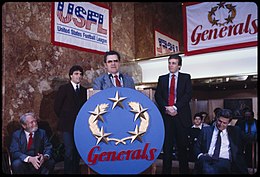
In September 1983, Trump purchased the New Jersey Generals, a team in the United States Football League. After the 1985 season, the league folded, largely due to his attempt to move to a fall schedule (when it would have competed with the NFL for audience) and trying to force a merger with the NFL by bringing an antitrust suit.
Trump and his Plaza Hotel hosted several boxing matches at the Atlantic City Convention Hall. In 1989 and 1990, he lent his name to the Tour de Trump cycling stage race, an attempt to create an American equivalent of European races such as the Tour de France or the Giro d’Italia.
From 1986 to 1988, Trump purchased significant blocks of shares in various public companies while suggesting that he intended to take over the company and then sold his shares for a profit, leading some observers to think he was engaged in greenmail. The New York Times found that he initially made millions of dollars in such stock transactions, but “lost most, if not all, of those gains after investors stopped taking his takeover talk seriously”.
In 1988, Trump purchased the Eastern Air Lines Shuttle, financing the purchase with $380 million (equivalent to $979 million in 2023) in loans from a syndicate of 22 banks. He renamed the airline Trump Shuttle and operated it until 1992. He defaulted on his loans in 1991, and ownership passed to the banks.
In 1992, Trump, his siblings Maryanne, Elizabeth, and Robert, and his cousin John W. Walter, each with a 20 percent share, formed All County Building Supply & Maintenance Corp. The company had no offices and is alleged to have been a shell company for paying the vendors providing services and supplies for Trump’s rental units, then billing those services and supplies to Trump Management with markups of 20–50 percent and more. The owners shared the proceeds generated by the markups. The increased costs were used to get state approval for increasing the rents of his rent-stabilized units.
From 1996 to 2015, Trump owned all or part of the Miss Universe pageants, including Miss USA and Miss Teen USA. Due to disagreements with CBS about scheduling, he took both pageants to NBC in 2002. In 2007, he received a star on the Hollywood Walk of Fame for his work as producer of Miss Universe. NBC and Univision dropped the pageants in June 2015.
Trump University
In 2004, Trump co-founded Trump University, a company that sold real estate seminars for up to $35,000. After New York State authorities notified the company that its use of “university” violated state law (as it was not an academic institution), its name was changed to the Trump Entrepreneur Initiative in 2010.
In 2013, the State of New York filed a $40 million civil suit against Trump University, alleging that the company made false statements and defrauded consumers. Additionally, two class actions were filed in federal court against Trump and his companies. Internal documents revealed that employees were instructed to use a hard-sell approach, and former employees testified that Trump University had defrauded or lied to its students. Shortly after he won the 2016 presidential election, he agreed to pay a total of $25 million to settle the three cases.
Foundation
The Donald J. Trump Foundation was a private foundation established in 1988. From 1987 to 2006, Trump gave his foundation $5.4 million which had been spent by the end of 2006. After donating a total of $65,000 in 2007–2008, he stopped donating any personal funds to the charity, which received millions from other donors, including $5 million from Vince McMahon. The foundation gave to health- and sports-related charities, conservative groups, and charities that held events at Trump properties.
In 2016, The Washington Post reported that the charity committed several potential legal and ethical violations, including alleged self-dealing and possible tax evasion. Also in 2016, the New York attorney general determined the foundation to be in violation of state law, for soliciting donations without submitting to required annual external audits, and ordered it to cease its fundraising activities in New York immediately. Trump’s team announced in December 2016 that the foundation would be dissolved.
In June 2018, the New York attorney general’s office filed a civil suit against the foundation, Trump, and his adult children, seeking $2.8 million in restitution and additional penalties. In December 2018, the foundation ceased operation and disbursed its assets to other charities. In November 2019, a New York state judge ordered Trump to pay $2 million to a group of charities for misusing the foundation’s funds, in part to finance his presidential campaign.
Legal Affairs and Bankruptcies
Roy Cohn was Trump’s fixer, lawyer, and mentor for 13 years in the 1970s and 1980s. According to Trump, Cohn sometimes waived fees due to their friendship. In 1973, Cohn helped Trump countersue the U.S. government for $100 million (equivalent to $686 million in 2023) over its charges that Trump’s properties had racial discriminatory practices.
Trump’s counterclaims were dismissed, and the government’s case was settled with the Trumps signing a consent decree agreeing to desegregate. In 1975, an agreement was struck requiring Trump’s properties to furnish the New York Urban League with a list of all apartment vacancies, every week for two years, among other things. Cohn introduced political consultant Roger Stone to Trump, who enlisted Stone’s services to deal with the federal government.
According to a review of state and federal court files conducted by USA Today in 2018, Trump and his businesses had been involved in more than 4,000 state and federal legal actions. While he has not filed for personal bankruptcy, his over-leveraged hotel and casino businesses in Atlantic City and New York filed for Chapter 11 bankruptcy protection six times between 1991 and 2009. They continued to operate while the banks restructured debt and reduced his shares in the properties.
During the 1980s, more than 70 banks had lent Trump $4 billion. After his corporate bankruptcies of the early 1990s, most major banks, with the exception of Deutsche Bank, declined to lend to him. After the January 6 Capitol attack, the bank decided not to do business with him or his company in the future.
Media Career
Trump has produced 19 books under his name. At least some of them have been written or co-written by ghostwriters. His first book, The Art of the Deal (1987), was a New York Times Best Seller. While he was credited as co-author, the entire book was written by Tony Schwartz. According to The New Yorker, the book made Trump famous as an “emblem of the successful tycoon”.

Trump had cameos in many films and television shows from 1985 to 2001. Starting in the 1990s, Trump was a guest about 24 times on the nationally syndicated Howard Stern Show. He had his own short-form talk radio program called Trumped! from 2004 to 2008. From 2011 until 2015, he was a guest commentator on Fox & Friends.
From 2004 to 2015, Trump was co-producer and host of reality shows The Apprentice and The Celebrity Apprentice. On the shows, he was a superrich and successful chief executive who eliminated contestants with the catchphrase “you’re fired”. The New York Times called his portrayal a “highly flattering, highly fictionalized version of Mr. Trump”. The shows remade his image for millions of viewers nationwide. With the related licensing agreements, they earned him more than $400 million.
In February 2021, Trump, who had been a member of SAG-AFTRA since 1989, resigned to avoid a disciplinary hearing regarding the January 6 attack. Two days later, the union permanently barred him.