
Early political aspirations (1987–2014)
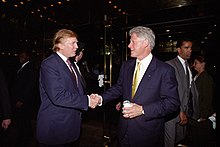
Trump registered as a Republican in 1987; a member of the Independence Party, the New York state affiliate of the Reform Party, in 1999; a Democrat in 2001; a Republican in 2009; unaffiliated in 2011; and a Republican in 2012.
In 1987, Trump placed full-page advertisements in three major newspapers, expressing his views on foreign policy and how to eliminate the federal budget deficit. In 1988, he approached Lee Atwater, asking to be put into consideration to be Republican nominee George H. W. Bush’s running mate. Bush found the request “strange and unbelievable”.
Trump was a candidate in the 2000 Reform Party presidential primaries for three months, but withdrew from the race in February 2000.
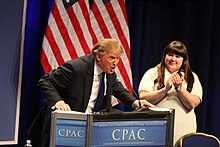
In 2011, Trump speculated about running against President Barack Obama in the 2012 election, making his first speaking appearance at the Conservative Political Action Conference (CPAC) in February 2011 and giving speeches in early primary states. In May 2011, he announced he would not run. His presidential ambitions were generally not taken seriously at the time.
2016 Presidential Election
Campaign
Trump announced his candidacy in June 2015. His campaign was initially not taken seriously by political analysts, but he quickly rose to the top of opinion polls. He became the front-runner in March 2016 and was declared the presumptive Republican nominee in May.
Trump’s fame and provocative statements earned him an unprecedented amount of free media coverage, elevating his standing in the Republican primaries. He adopted the phrase “truthful hyperbole”, coined by his ghostwriter Tony Schwartz, to describe his public speaking style. His campaign statements were often opaque and suggestive, and a record number were false. He said he disdained political correctness and frequently made claims of media bias.

Hillary Clinton led Trump in national polling averages throughout the campaign, but, in early July, her lead narrowed. In mid-July he selected Indiana governor Mike Pence as his running mate, and the two were officially nominated at the 2016 Republican National Convention.
Trump and Clinton faced off in three presidential debates in September and October 2016. He twice refused to say whether he would accept the result of the election.
Trump described NATO as “obsolete” and espoused views that were described as noninterventionist and protectionist. His campaign platform emphasized renegotiating U.S.–China relations and free trade agreements such as NAFTA, strongly enforcing immigration laws, and building a new wall along the U.S.–Mexico border. Other campaign positions included pursuing energy independence while opposing climate change regulations, modernizing services for veterans, repealing and replacing the Affordable Care Act, abolishing Common Core education standards, investing in infrastructure, simplifying the tax code while reducing taxes, and imposing tariffs on imports by companies that offshore jobs. He advocated increasing military spending and extreme vetting or banning of immigrants from Muslim-majority countries.
Financial disclosures
Trump’s FEC-required reports listed assets above $1.4 billion and outstanding debts of at least $315 million. He did not release his tax returns, contrary to the practice of every major candidate since 1976 and his promises in 2014 and 2015 to do so if he ran for office.
He said his tax returns were being audited, and that his lawyers had advised him against releasing them. After a lengthy court battle to block release of his tax returns and other records to the Manhattan district attorney for a criminal investigation, including two appeals by Trump to the U.S. Supreme Court, in February 2021 the high court allowed the records to be released to the prosecutor for review by a grand jury.
In October 2016, portions of Trump’s state filings for 1995 were leaked to a reporter from The New York Times. They show that he had declared a loss of $916 million that year, which could have let him avoid taxes for up to 18 years.
Results
On November 8, 2016, Trump received 306 pledged electoral votes versus 232 for Clinton, although, after elector defections on both sides, the official count was ultimately 304 to 227. The fifth person to be elected president while losing the popular vote, he received nearly 2.9 million fewer votes than Clinton. He was the only president who neither served in the military nor held any government office prior to becoming president.

Trump won 30 states, including Michigan, Pennsylvania, and Wisconsin, states which had been considered a blue wall of Democratic strongholds since the 1990s. Clinton won 20 states and the District of Columbia. His victory marked the return of an undivided Republican government—a Republican White House combined with Republican control of both chambers of Congress.
In late 2016, Time named Trump its Person of the Year.
Trump’s election victory sparked protests in major U.S. cities. On the day after his inauguration, an estimated 2.6 million people worldwide, including an estimated half million in Washington, D.C., protested against him in the Women’s Marches.