
First presidency (2017–2021)
Early actions

Trump was inaugurated on January 20, 2017. During his first week in office, he signed six executive orders, authorizing interim procedures in anticipation of repealing the Patient Protection and Affordable Care Act (“Obamacare”), withdrawal from the Trans-Pacific Partnership negotiations, reinstatement of the Mexico City policy, advancement of the Keystone XL and Dakota Access Pipeline construction projects, reinforcement of border security, and a planning and design process to construct a wall along the U.S. border with Mexico.
Trump’s daughter Ivanka and son-in-law Jared Kushner became his assistant and senior advisor, respectively.
Conflicts of interest
Before being inaugurated, Trump moved his businesses into a revocable trust, rather than a blind trust or equivalent arrangement “to cleanly sever himself from his business interests”. He continued to profit from his businesses and to know how his administration’s policies affected his businesses.
Although he said he would eschew “new foreign deals”, the Trump Organization pursued expansions of its operations in Scotland, Dubai, and the Dominican Republic. During Trump’s first two years in office, his golf course resorts and hotels drew a growing number of lobbyists, foreign government officials, and Trump donors and allies, generating hundreds of millions of dollars. By mid-2019, Trump had visited his properties at least 345 times.
Trump was sued for violating the Domestic and Foreign Emoluments Clauses of the U.S. Constitution, marking the first time that the clauses had been substantively litigated. One case was dismissed in lower court. Two were dismissed by the U.S. Supreme Court as moot after the end of his term.
Domestic policy
Trump took office at the height of the longest economic expansion in American history, which began in 2009 and continued until February 2020, when the COVID-19 recession began.
In December 2017, Trump signed the Tax Cuts and Jobs Act of 2017. It reduced tax rates for businesses and individuals and set the penalty associated with the Affordable Care Act’s individual mandate to $0. The Trump administration claimed that the act would not decrease government revenue, but 2018 revenues were 7.6 percent lower than projected.
Under Trump, the federal budget deficit increased by almost 50 percent, to nearly $1 trillion in 2019. By the end of his term, the U.S. national debt increased by 39 percent, reaching $27.75 trillion, and the U.S. debt-to-GDP ratio hit a post-World War II high. Trump also failed to deliver the $1 trillion infrastructure spending plan on which he had campaigned.
Trump is the only modern U.S. president to leave office with a smaller workforce than when he took office, by 3 million people.
Trump rejects the scientific consensus on climate change. He reduced the budget for renewable energy research by 40 percent and reversed Obama-era policies directed at curbing climate change. He withdrew from the Paris Agreement, making the U.S. the only nation to not ratify it.
Trump aimed to boost the production and exports of fossil fuels. Natural gas expanded under Trump, but coal continued to decline. He rolled back more than 100 federal environmental regulations, including those that curbed greenhouse gas emissions, air and water pollution, and the use of toxic substances. He weakened protections for animals and environmental standards for federal infrastructure projects, and expanded permitted areas for drilling and resource extraction, such as allowing drilling in the Arctic Refuge.
In 2017, Trump signed Executive Order 13771, which directed that, for every new regulation, federal agencies “identify” two existing regulations for elimination, although it did not require elimination. He dismantled many federal regulations on health, labor, and the environment, among others, including a bill that made it easier for severely mentally ill persons to buy guns.
During his first six weeks in office, he delayed, suspended, or reversed ninety federal regulations, often “after requests by the regulated industries”. The Institute for Policy Integrity found that 78 percent of his proposals were blocked by courts or did not prevail over litigation.
During his campaign, Trump vowed to repeal and replace the Affordable Care Act. In office, he scaled back the Act’s implementation through executive orders. He expressed a desire to “let Obamacare fail”; his administration halved the enrollment period and drastically reduced funding for enrollment promotion.
In June 2018, the Trump administration joined 18 Republican-led states in arguing before the Supreme Court that the elimination of the financial penalties associated with the individual mandate had rendered the Act unconstitutional.
Their pleading would have eliminated health insurance coverage for up to 23 million Americans, but was unsuccessful. During the 2016 campaign, Trump promised to protect funding for Medicare and other social safety-net programs. In January 2020, he expressed willingness to consider cuts to them.
In response to the opioid epidemic, Trump signed legislation in 2018 to increase funding for drug treatments, but was widely criticized for failing to make a concrete strategy. U.S. opioid overdose deaths declined slightly in 2018, but surged to a record 50,052 in 2019.
Trump barred organizations that provide abortions or abortion referrals from receiving federal funds. He said he supported “traditional marriage”, but considered the nationwide legality of same-sex marriage “settled”. His administration rolled back key components of the Obama administration’s workplace protections against discrimination of LGBTQ people.
His attempted rollback of anti-discrimination protections for transgender patients in August 2020 was halted by a federal judge after a Supreme Court ruling extended employees’ civil rights protections to gender identity and sexual orientation.
Trump has said he is opposed to gun control, although his views have shifted over time. After several mass shootings during his term, he said he would propose legislation related to guns, but he abandoned that effort in November 2019. His administration took an anti-marijuana position, revoking Obama-era policies that provided protections for states that legalized marijuana.
Trump is a long-time advocate of capital punishment. Under his administration, the federal government executed 13 prisoners, more than in the previous 56 years combined, ending a 17-year moratorium. In 2016, he said he supported the use of interrogation torture methods such as waterboarding.
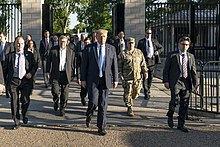
In June 2020, during the George Floyd protests, federal law-enforcement officials controversially used less lethal weapons to remove a largely peaceful crowd of lawful protesters from Lafayette Square, outside the White House.
Trump then posed with a Bible for a photo-op at the nearby St. John’s Episcopal Church, with religious leaders condemning both the treatment of protesters and the photo opportunity itself. Many retired military leaders and defense officials condemned his proposal to use the U.S. military against anti-police-brutality protesters.
Pardons and Commutations
Trump granted 237 requests for clemency, fewer than all presidents since 1900 with the exception of George H. W. Bush and George W. Bush. Only 25 of them had been vetted by the Justice Department’s Office of the Pardon Attorney; the others were granted to people with personal or political connections to him, his family, and his allies, or recommended by celebrities.
In his last full day in office, he granted 73 pardons and commuted 70 sentences. Several Trump allies were not eligible for pardons under Justice Department rules, and in other cases the department had opposed clemency. The pardons of three military service members convicted of or charged with violent crimes were opposed by military leaders.