
Immigration
Trump’s proposed immigration policies were a topic of bitter debate during the 2016 campaign. He promised to build a wall on the Mexico–U.S. border to restrict illegal movement and vowed that Mexico would pay for it. He pledged to deport millions of illegal immigrants residing in the U.S., and criticized birthright citizenship for incentivizing “anchor babies”. As president, he frequently described illegal immigration as an “invasion” and conflated immigrants with the criminal gang MS-13.
Trump drastically escalated immigration enforcement, including implementing harsher immigration enforcement policies against asylum seekers from Central America than any modern U.S. president.
From 2018 onward, Trump deployed nearly 6,000 troops to the U.S.–Mexico border to stop most Central American migrants from seeking asylum. In 2020, his administration widened the public charge rule to further restrict immigrants who might use government benefits from getting permanent residency.
He reduced the number of refugees admitted to record lows. When he took office, the annual limit was 110,000; he set a limit of 18,000 in the 2020 fiscal year and 15,000 in the 2021 fiscal year. Additional restrictions implemented by the Trump administration caused significant bottlenecks in processing refugee applications, resulting in fewer refugees accepted than the allowed limits.
Travel Ban
Following the 2015 San Bernardino attack, Trump proposed to ban Muslim foreigners from entering the U.S. until stronger vetting systems could be implemented. He later reframed the proposed ban to apply to countries with a “proven history of terrorism”.
On January 27, 2017, Trump signed Executive Order 13769, which suspended admission of refugees for 120 days and denied entry to citizens of Iraq, Iran, Libya, Somalia, Sudan, Syria, and Yemen for 90 days, citing security concerns. The order took effect immediately and without warning, causing chaos at airports. Protests began at airports the next day, and legal challenges resulted in nationwide preliminary injunctions.
A March 6 revised order, which excluded Iraq and gave other exemptions, again was blocked by federal judges in three states. In a decision in June 2017, the Supreme Court ruled that the ban could be enforced on visitors who lack a “credible claim of a bona fide relationship with a person or entity in the United States”.
The temporary order was replaced by Presidential Proclamation 9645 on September 24, 2017, which restricted travel from the originally targeted countries except Iraq and Sudan, and further banned travelers from North Korea and Chad, along with certain Venezuelan officials. After lower courts partially blocked the new restrictions, the Supreme Court allowed the September version to go into full effect on December 4, 2017, and ultimately upheld the travel ban in a ruling in June 2019.
Family separation at the border

The Trump administration separated more than 5,400 children of migrant families from their parents at the U.S.–Mexico border, a sharp increase in the number of family separations at the border starting from the summer of 2017. In April 2018, the administration announced a “zero tolerance” policy whereby adults suspected of illegal entry were to be detained and criminally prosecuted while their children were taken away as unaccompanied alien minors.
The policy was unprecedented in previous administrations and sparked public outrage. Trump falsely asserted that his administration was merely following the law, blaming Democrats, despite the separations being his administration’s policy.
Although Trump originally argued that the separations could not be stopped by an executive order, he acceded to intense public objection and signed an executive order in June 2018, mandating that migrant families be detained together unless “there is a concern” of a risk to the child.
On June 26, 2018, Judge Dana Sabraw concluded that the Trump administration had “no system in place to keep track of” the separated children, nor any effective measures for family communication and reunification; Sabraw ordered for the families to be reunited and family separations stopped except in limited circumstances. After the order, the administration separated more than a thousand migrant children from their families; the ACLU contended that the administration had abused its discretion and asked Sabraw to more narrowly define the circumstances warranting separation.
Trump wall and government shutdown
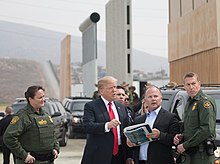
One of Trump’s central campaign promises was to build a 1,000-mile (1,600 km) border wall to Mexico and have Mexico pay for it. By the end of his term, the U.S. had built “40 miles [64 km] of new primary wall and 33 miles [53 km] of secondary wall” in locations where there had been no barriers and 365 miles (587 km) of primary or secondary border fencing replacing dilapidated or outdated barriers.
In 2018, Trump refused to sign any appropriations bill from Congress unless it allocated $5.6 billion for the border wall, resulting in the federal government partially shutting down for 35 days from December 2018 to January 2019, the longest U.S. government shutdown in history.
Around 800,000 government employees were furloughed or worked without pay. Trump and Congress ended the shutdown by approving temporary funding that provided delayed payments to government workers, but no funds for the wall. The shutdown resulted in an estimated permanent loss of $3 billion to the economy, according to the Congressional Budget Office. About half of those polled blamed Trump for the shutdown, and his approval ratings dropped.
To prevent another imminent shutdown in February 2019, Congress passed and Trump signed a funding bill that included $1.375 billion for 55 miles (89 km) of bollard border fencing. He also declared a national emergency on the southern border, intending to divert $6.1 billion of funds Congress had allocated to other purposes. He vetoed a joint resolution to overturn the declaration, and the Senate voted against a veto override. Legal challenges to the diversion of $2.5 billion originally meant for the Department of Defense’s drug interdiction efforts and $3.6 billion originally meant for military construction were unsuccessful.