
Foreign Policy

Trump described himself as a “nationalist” and his foreign policy as “America First”. He praised and supported populist, neo-nationalist, and authoritarian governments. Hallmarks of foreign relations during his tenure included unpredictability, uncertainty, and inconsistency.
Tensions between the U.S. and its European allies were strained under Trump. He criticized NATO allies and privately suggested on multiple occasions that the U.S. should withdraw from NATO.
Trade
Trump withdrew the U.S. from the Trans-Pacific Partnership (TPP) negotiations, imposed tariffs on steel and aluminum imports, and launched a trade war with China by sharply increasing tariffs on 818 categories (worth $50 billion) of Chinese goods imported into the U.S. While he said that import tariffs are paid by China into the U.S. Treasury, they are paid by American companies that import goods from China.
Although he pledged during the campaign to significantly reduce the U.S.’s large trade deficits, the trade deficit skyrocketed under Trump. Following a 2017–2018 renegotiation, the United States–Mexico–Canada Agreement (USMCA) became effective in July 2020 as the successor to NAFTA.
Russia
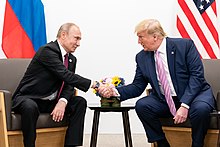
The Trump administration weakened the toughest sanctions imposed by the U.S. against Russian entities after Russia’s 2014 annexation of Crimea. Trump withdrew the U.S. from the Intermediate-Range Nuclear Forces Treaty, citing alleged Russian noncompliance, and supported a potential return of Russia to the G7.
Trump repeatedly praised and rarely criticized Russian president Vladimir Putin but opposed some actions of the Russian government. After he met Putin at the Helsinki Summit in 2018, he drew bipartisan criticism for accepting Putin’s denial of Russian interference in the 2016 presidential election, rather than accepting the findings of U.S. intelligence agencies. He did not discuss alleged Russian bounties offered to Taliban fighters for attacking American soldiers in Afghanistan with Putin, saying both that he doubted the intelligence and that he was not briefed on it.
East Asia
China, Hong Kong, Taiwan
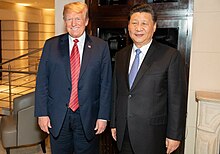
Trump repeatedly accused China of taking unfair advantage of the U.S. He launched a trade war against China that was widely characterized as a failure, sanctioned Huawei for alleged ties to Iran, significantly increased visa restrictions on Chinese students and scholars, and classified China as a currency manipulator.
He also juxtaposed verbal attacks on China with praise of Chinese Communist Party leader Xi Jinping, which was attributed to trade war negotiations. After initially praising China for its handling of COVID-19, he began a campaign of criticism starting in March 2020.
Trump said he resisted punishing China for its human rights abuses against ethnic minorities in the Xinjiang region for fear of jeopardizing trade negotiations. In July 2020, his administration imposed sanctions and visa restrictions against senior Chinese officials, in response to expanded mass detention camps holding more than a million of the country’s Uyghur minority.
North Korea

In 2017, when North Korea’s nuclear weapons were increasingly seen as a serious threat, Trump escalated his rhetoric, warning that North Korean aggression would be met with “fire and fury like the world has never seen”. In 2017, he declared that he wanted North Korea’s “complete denuclearization”, and engaged in name-calling with leader Kim Jong Un.
After this period of tension, he and Kim exchanged at least 27 letters in which the two men described a warm personal friendship. In March 2019, he lifted some U.S. sanctions against North Korea against the advice of his Treasury Department.
Trump, the first sitting U.S. president to meet a North Korean leader, met Kim three times: in Singapore in 2018, in Hanoi in 2019, and in the Korean Demilitarized Zone in 2019. However, no denuclearization agreement was reached, and talks in October 2019 broke down after one day. While conducting no nuclear tests since 2017, North Korea continued to build up its arsenal of nuclear bombs and ballistic missiles.
Middle East
Afghanistan
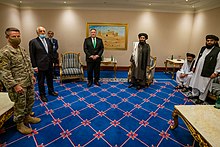
U.S. troop numbers in Afghanistan increased from 8,500 in January 2017 to 14,000 a year later, reversing Trump’s preelection position critical of further involvement in Afghanistan. In February 2020, his administration signed a peace agreement with the Taliban, which called for the withdrawal of foreign troops in 14 months “contingent on a guarantee from the Taliban that Afghan soil will not be used by terrorists with aims to attack the United States or its allies” and for the U.S. to seek the release of 5,000 Taliban imprisoned by the Afghan government. By the end of his term, 5,000 Taliban had been released, and, despite the Taliban continuing attacks on Afghan forces and integrating Al-Qaeda members into its leadership, U.S. troops had been reduced to 2,500.
Israel
Trump supported many of the policies of Israeli Prime Minister Benjamin Netanyahu. Under Trump, the U.S. recognized Jerusalem as the capital of Israel and Israeli sovereignty over the Golan Heights, leading to international condemnation including from the UN General Assembly, European Union, and Arab League. In 2020, the White House hosted the signing of agreements, named Abraham Accords, between Israel and the United Arab Emirates and Bahrain to normalize their foreign relations.
Saudi Arabia

Trump actively supported the Saudi Arabian–led intervention in Yemen against the Houthis and in 2017 signed a $110 billion agreement to sell arms to Saudi Arabia. In 2018, the U.S. provided limited intelligence and logistical support for the intervention.
Following the 2019 attack on Saudi oil facilities, which the U.S. and Saudi Arabia blamed on Iran, he approved the deployment of 3,000 additional U.S. troops, including fighter squadrons, two Patriot batteries, and a Terminal High Altitude Area Defense system, to Saudi Arabia and the United Arab Emirates.
Syria
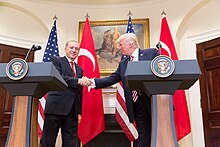
Trump ordered missile strikes in April 2017 and April 2018 against the Assad regime in Syria, in retaliation for the Khan Shaykhun and Douma chemical attacks, respectively. In December 2018, he declared “we have won against ISIS”, contradicting Department of Defense assessments, and ordered the withdrawal of all troops from Syria. The next day, Mattis resigned in protest, calling Trump’s decision an abandonment of the U.S.’s Kurdish allies who played a key role in fighting ISIS.
In October 2019, after Trump spoke to Turkish president Recep Tayyip Erdoğan, U.S. troops in northern Syria were withdrawn from the area and Turkey invaded northern Syria, attacking and displacing American-allied Kurds. The U.S. House of Representatives voted 354–60 to condemn Trump’s withdrawal of those U.S. troops from Syria.
Iran
In May 2018, Trump withdrew the U.S. from the Joint Comprehensive Plan of Action, the 2015 agreement that lifted most economic sanctions against Iran in return for restrictions on Iran’s nuclear program. In August 2020, his administration unsuccessfully attempted to use a section of the nuclear deal to have the UN reimpose sanctions against Iran. Analysts determined that, after the U.S. withdrawal, Iran moved closer to developing a nuclear weapon.
On January 1, 2020, Trump ordered a U.S. airstrike that killed Iranian general Qasem Soleimani, who had planned nearly every significant Iranian and Iranian-backed operation over the preceding two decades. One week later, Iran retaliated with ballistic missile strikes against two U.S. airbases in Iraq. Dozens of soldiers sustained traumatic brain injuries. He downplayed their injuries, and they were initially denied Purple Heart medals and the benefits accorded to their recipients.