
COVID-19 pandemic
Initial response
The first confirmed case of COVID-19 in the U.S. was reported on January 20, 2020. The outbreak was officially declared a public health emergency by Health and Human Services (HHS) Secretary Alex Azar on January 31, 2020. Trump initially ignored persistent public health warnings and calls for action from health officials within his administration and Secretary Azar.
Throughout January and February he focused on economic and political considerations of the outbreak. In February 2020 he publicly asserted that the outbreak in the U.S. was less deadly than influenza, was “very much under control”, and would soon be over. On March 19, 2020, he privately told Bob Woodward that he was deliberately “playing it down, because I don’t want to create a panic”.
By mid-March, most global financial markets had severely contracted in response to the pandemic. On March 6, Trump signed the Coronavirus Preparedness and Response Supplemental Appropriations Act, which provided $8.3 billion in emergency funding for federal agencies.
On March 11, the World Health Organization (WHO) recognized COVID-19 as a pandemic, and he announced partial travel restrictions for most of Europe, effective March 13. That same day, he gave his first serious assessment of the virus in a nationwide Oval Office address, calling the outbreak “horrible” but “a temporary moment” and saying there was no financial crisis. On March 13, he declared a national emergency, freeing up federal resources. He claimed that “anybody that wants a test can get a test”, despite test availability being severely limited.
On April 22, Trump signed an executive order restricting some forms of immigration. In late spring and early summer, with infections and deaths continuing to rise, he adopted a strategy of blaming the states rather than accepting that his initial assessments of the pandemic were overly optimistic or his failure to provide presidential leadership.
White House Coronavirus Task Force
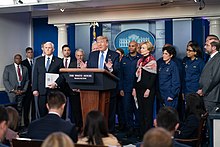
Trump established the White House Coronavirus Task Force on January 29, 2020. Beginning in mid-March, he held a daily task force press conference, joined by medical experts and other administration officials, sometimes disagreeing with them by promoting unproven treatments.
He was the main speaker at the briefings, where he praised his own response to the pandemic, frequently criticized rival presidential candidate Joe Biden, and denounced the press. On March 16, he acknowledged for the first time that the pandemic was not under control and that months of disruption to daily lives and a recession might occur. His repeated use of “Chinese virus” and “China virus” to describe COVID-19 drew criticism from health experts.
By early April, as the pandemic worsened and amid criticism of his administration’s response, Trump refused to admit any mistakes in his handling of the outbreak, instead blaming the media, Democratic state governors, the previous administration, China, and the WHO. The daily coronavirus task force briefings ended in late April, after a briefing at which he suggested the dangerous idea of injecting a disinfectant to treat COVID-19; the comment was widely condemned by medical professionals.
In early May, Trump proposed the phase-out of the coronavirus task force and its replacement with another group centered on reopening the economy. Amid a backlash, he said the task force would “indefinitely” continue. By the end of May, the coronavirus task force’s meetings were sharply reduced.
World Health Organization
Prior to the pandemic, Trump criticized the WHO and other international bodies, which he asserted were taking advantage of U.S. aid.
His administration’s proposed 2021 federal budget, released in February, proposed reducing WHO funding by more than half. In May and April, he accused the WHO of “severely mismanaging” COVID-19, alleged without evidence that the organization was under Chinese control and had enabled the Chinese government’s concealment of the pandemic’s origins, and announced that he was withdrawing funding for the organization.
These were seen as attempts to distract from his own mishandling of the pandemic. In July 2020, he announced the formal withdrawal of the U.S. from the WHO, effective July 2021. The decision was widely condemned by health and government officials as “short-sighted”, “senseless”, and “dangerous”.
Pressure to abandon pandemic mitigation measures
In April 2020, Republican-connected groups organized anti-lockdown protests against the measures state governments were taking to combat the pandemic; Trump encouraged the protests on Twitter, although the targeted states did not meet his administration’s guidelines for reopening. In April 2020, he first supported, then later criticized, Georgia Governor Brian Kemp’s plan to reopen some nonessential businesses.
Throughout the spring he increasingly pushed for ending the restrictions to reverse the damage to the country’s economy. He often refused to mask at public events, contrary to his administration’s April 2020 guidance to wear masks in public and despite nearly unanimous medical consensus that masks are important to preventing spread of the virus.
By June, he had said masks were a “double-edged sword”; ridiculed Biden for wearing masks; continually emphasized that mask-wearing was optional; and suggested that wearing a mask was a political statement against him personally. His contradiction of medical recommendations weakened national efforts to mitigate the pandemic.
In June and July, Trump said several times that the U.S. would have fewer cases of coronavirus if it did less testing, that having a large number of reported cases “makes us look bad”. The CDC guideline at the time was that any person exposed to the virus should be “quickly identified and tested” even if they are not showing symptoms, because asymptomatic people can still spread the virus.
In August 2020 the CDC quietly lowered its recommendation for testing, advising that people who have been exposed to the virus, but are not showing symptoms, “do not necessarily need a test”. The change in guidelines was made by HHS political appointees under Trump administration pressure, against the wishes of CDC scientists. The day after this political interference was reported, the testing guideline was changed back to its original recommendation.
Despite record numbers of COVID-19 cases in the U.S. from mid-June onward and an increasing percentage of positive test results, Trump largely continued to downplay the pandemic, including his false claim in early July 2020 that 99 percent of COVID-19 cases are “totally harmless”. He began insisting that all states should resume in-person education in the fall despite a July spike in reported cases.
Political pressure on health agencies
Trump repeatedly pressured federal health agencies to take actions he favored, such as approving unproven treatments or speeding up vaccine approvals. Trump administration political appointees at HHS sought to control CDC communications to the public that undermined his claims that the pandemic was under control. CDC resisted many of the changes, but increasingly allowed HHS personnel to review articles and suggest changes before publication. Trump alleged without evidence that FDA scientists were part of a “deep state” opposing him and delaying approval of vaccines and treatments to hurt him politically.
Outbreak at the White House

On October 2, 2020, Trump tweeted that he had tested positive for COVID-19, part of a White House outbreak. Later that day he was hospitalized at Walter Reed National Military Medical Center, reportedly due to fever and labored breathing. He was treated with antiviral and experimental antibody drugs and a steroid. He returned to the White House on October 5, still infectious and unwell.
During and after his treatment he continued to downplay the virus. In 2021, it was revealed that his condition had been far more serious; he had dangerously low blood oxygen levels, a high fever, and lung infiltrates, indicating a severe case. In January 2021, he received a COVID-19 vaccination.
Effects on the 2020 presidential campaign
By July 2020, Trump’s handling of the COVID-19 pandemic had become a major issue in the presidential election. Biden sought to make the pandemic the central issue. Polls suggested voters blamed Trump for his pandemic response and disbelieved his rhetoric concerning the virus, with an Ipsos/ABC News poll indicating 65 percent of respondents disapproved of his pandemic response.
In the final months of the campaign, he repeatedly said that the U.S. was “rounding the turn” in managing the pandemic, despite increasing cases and deaths. A few days before the November 3 election, the U.S. reported more than 100,000 cases in a single day for the first time.