
Personnel
The Trump administration had a high turnover of personnel, particularly among White House staff. By the end of his first year in office, 34 percent of his original staff had resigned, been fired, or been reassigned. As of early July 2018, 61 percent of his senior aides had left and 141 staffers had left in the previous year.
Both figures set a record for recent presidents—more change in the first 13 months than his four immediate predecessors saw in their first two years. Notable early departures included National Security Advisor Michael Flynn (after just 25 days), and Press Secretary Sean Spicer. Close personal aides to Trump including Bannon, Hope Hicks, John McEntee, and Keith Schiller quit or were forced out. Some later returned in different posts. He publicly disparaged several of his former top officials, calling them incompetent, stupid, or crazy.
Trump had four White House chiefs of staff, marginalizing or pushing out several. Reince Priebus was replaced after seven months by retired Marine general John F. Kelly Kelly resigned in December 2018 after a tumultuous tenure in which his influence waned, and Trump subsequently disparaged him. Kelly was succeeded by Mick Mulvaney as acting chief of staff; he was replaced in March 2020 by Mark Meadows.
On May 9, 2017, Trump dismissed FBI director James Comey. While initially attributing this action to Comey’s conduct in the investigation about Hillary Clinton’s emails, Trump said a few days later that he was concerned with Comey’s role in the ongoing Trump-Russia investigations, and that he had intended to fire Comey earlier. At a private conversation in February, he said he hoped Comey would drop the investigation into Flynn. In March and April, he asked Comey to “lift the cloud impairing his ability to act” by saying publicly that the FBI was not investigating him.
Trump lost three of his 15 original cabinet members within his first year. Health and Human Services secretary Tom Price was forced to resign in September 2017 due to excessive use of private charter jets and military aircraft. Environmental Protection Agency administrator Scott Pruitt resigned in 2018 and Secretary of the Interior Ryan Zinke in January 2019 amid multiple investigations into their conduct.
Trump was slow to appoint second-tier officials in the executive branch, saying many of the positions are unnecessary. In October 2017, there were still hundreds of sub-cabinet positions without a nominee. By January 8, 2019, of 706 key positions, 433 had been filled (61 percent) and he had no nominee for 264 (37 percent).
Judiciary
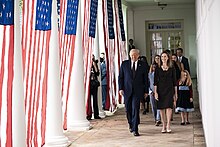
Trump appointed 226 Article III judges, including 54 to the courts of appeals and three to the Supreme Court: Neil Gorsuch, Brett Kavanaugh, and Amy Coney Barrett. His Supreme Court nominees were noted as having politically shifted the Court to the right.
In the 2016 campaign, he pledged that Roe v. Wade would be overturned “automatically” if he were elected and provided the opportunity to appoint two or three anti-abortion justices. He later took credit when Roe was overturned in Dobbs v. Jackson Women’s Health Organization; all three of his Supreme Court nominees voted with the majority.
Trump disparaged courts and judges he disagreed with, often in personal terms, and questioned the judiciary’s constitutional authority. His attacks on the courts drew rebukes from observers, including sitting federal judges, concerned about the effect of his statements on the judicial independence and public confidence in the judiciary.