MINING & MINERAL

DEFINITION OF MINING Mining: is the process of getting coal, gold and other minerals from under the ground by making a deep hole or holes where these minerals are dug. That is, it is an extraction of minerals from under…
Lesson Notes, Audio Lessons, Exam Questions
Lesson Notes, Audio Lessons, Exam Questions
Welcome to our Economics lesson notes section for all classes. Whether you’re preparing for WAEC, NECO, or any other exams, our well-detailed lesson notes cover all key topics in Economics.
Each lesson is designed to enhance your understanding of economic principles, concepts, and their real-world applications.
From basic principles to advanced economic theories, these notes are structured to make studying easier and more effective for students at all levels.
Access detailed and comprehensive Economics lesson notes for all classes. Ideal for students studying for WAEC, NECO, and other exams. Study and excel!
DEFINITION OF MINING Mining: is the process of getting coal, gold and other minerals from under the ground by making a deep hole or holes where these minerals are dug. That is, it is an extraction of minerals from under…
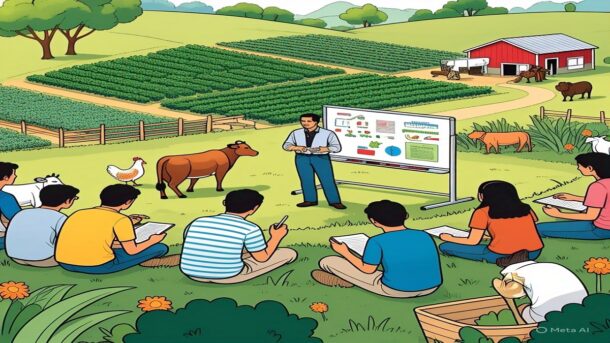
MEANING OF AGRICULTURE Agriculture can be defined as the production of crops, animals, fish and forest resources for the consumption and other benefits of humans. It is a dominant occupation which employs about 65-70% of the total population of West…
NATURE OF NIGERIA ECONOMY The study of the structure of an economy is in essence the study of the ‘Anatomy’ of that economy. The structure of Nigerian economy is a system whereby the organizational framework of the economy are inter-related,…
FREE MARKET ECONOMY A free market is a market in which prices of goods and services are regulated by market forces. This means that prices of commodities in a free market economy are fixed by the interaction (i.e. joint actions)…
Supply may be defined as the quantity of goods and services which sellers are willing and able to offer for sale at a particular price, and at a particular period of time. Supply does not mean the entire stock of…
Demand can be defined as the quantity of a commodity (goods and services) that consumers are willing and able to buy at a given price and at a particular place and time. Demand is quite different from wants, need or…
The middlemen are the wholesalers and the retailers who are in-between the producers and the consumers. They specialize in performing activities relating to purchase and sales of goods in the process of their flow from the manufacturers to the final…
Distributive Trade-which is also known as the chain of distribution, refers to the various stages or channels through which finished goods are moved from the manufacturers/producers to the final consumers . That is, it is the process of getting goods…
MERCHANT BANKS (INVESTMENT BANKS) This may be defined as financial institutions that provide medium and long loans, accept large deposits from customers and acts as issuing houses. They deal with high net worth individuals, companies, other financial institutions and government…
A negotiable instruments is an instrument whose title (or ownership) on it could be transferred by delivering it to another person with or without endorsement. Examples of negotiable instruments are bills of exchange, cheques, bank drafts, bill of lading, dividend…
A cheque is a bill of exchange drawn on a banker payable on demand PARTIES TO A CHEQUE There are three parties involved with a cheque namely: The Drawer – .i.e. the person who issues the cheque The Drawee –…
COMMERCIAL BANKS A commercial bank is a financial institution which accept deposits and other valuables from the public for safe-keeping lend money to people and firms and perform other auxiliary services with the sole aim of making profit. A commercial…
The Central Bank is the apex financial institution in a country which is responsible for the management and control of monetary affairs of the country. FEATURES/CHARACTERISTICS OF THE CENTRAL BANK It is owned by the government It is established through…
TRADE BY BARTER Before money came to be used, trade was carried out by goods being exchanged directly for other goods. This direct exchange of goods for goods is known as barter. Trade by barter is a form of trading…
TYPES OF PARTNERSHIP There are two main types of partnership business namely: Ordinary Partnership (or General partnership) The Limited Partnership THE ORDINARY PARTNERSHIP (GENERAL PARTNERSHIP) Characteristics or features: Membership/Number of partners: May consist of between 2 to 20 persons. However…
A partnership is defined as the relationship that exists between two or more (but more than twenty) persons carrying on a business in common for the purpose of making profits. A partnership is the relationship that exist when two or…
The theory of the multiplier– states that an increase in consumer or business investment spending in a country would produce a multiplier effect by raising the level of national income. The multiplier effect can be as a result of changes…
CIRCULAR FLOW OF INCOME Circular flow of income shows the independence or relationship between households and business enterprise. Commodity and money flows between households and firms. It shows the flow of payments from business sector to households in exchange for…
As individuals and firms keep account of their economic activities such as their annual report which shows all their activities during the past year, countries too like individuals and firms do record and keep their economic activities. National Income–…
Capital Market- is a market for medium and long-term loans. The capital market serves the needs of industries and the commercial sectors. It comprises all institutions which are concerned with either the supply of or demand for long-term loans. The…