Table Cover
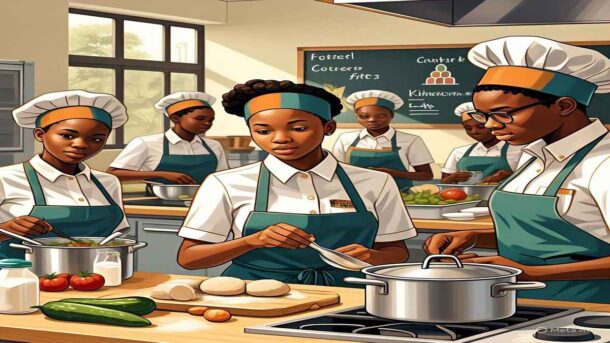
Cover literally means to cover the course and dishes with a large white napkin in order to indicate that all precautions had been taken to avoid the poisoning of guests. In modern food service operation, a cover refers to a…
Lesson Notes, Audio Lessons, Exam Questions
Lesson Notes, Audio Lessons, Exam Questions
Welcome to the Catering Lesson Notes for SS1 to SS3, designed to align with the WAEC and NECO curriculum. These notes cover key topics in Catering, including food preparation, nutrition, hospitality, and kitchen management.
Whether you’re revising for exams or learning new skills, these notes provide clear explanations to help you succeed.
Check our detailed lessons on various aspects of Catering, from meal planning to food safety, ensuring you’re fully prepared for your exams and practical assessments.
Access our well-explained Catering lesson notes for SS1 to SS3, covering topics aligned with the WAEC & NECO syllabus. Perfect for exam preparation and class revision.
Cover literally means to cover the course and dishes with a large white napkin in order to indicate that all precautions had been taken to avoid the poisoning of guests. In modern food service operation, a cover refers to a…
Table Laying This is the process of covering the restaurant/dining tables with table clothes. Nothing is more attractive in the room than tables clothed-up with clean, crisp and well starched linen table cloths and napkin. The table cloth and napkin…
Self Service This type of service is commonly found in cafeteria and canteens. It involves customers/guests serving themselves with little assistance from the waiters Types of Self Service Types of Buffet Basic Principles/Format in Setting up a Buffet Room EVALUATION…
Food service can be defined as the preparation, delivery and serving of ready to eat foods/meals in catering establishments. It is simply the manner of presenting prepared meals to the diners Types of Food Service Table Service Table service is…
Housekeeping may be defined as provision of calm, comfortable, safe and an aesthetically appealing environment. Housekeeping department is an operational department in a hotel, which is responsible for cleanliness, maintenance and beautification of the hotel and its surroundings such as…
This refers to the team who work together on shift basis, under the chef de cuisine (head chef) in the kitchen. Head Chef (Chef De Cuisine) The head chef performs mainly administrative duties of supervision in large establishments, but in…
Bar Personnel and Their Functions Bar Manager He is in charge of the bar. He reports directly to the F & B manager and works hand-in-hand with the restaurant manager. Responsibilities Bar Man/Bar Tender/Bar Keeper/ Mixologist They should have thorough…
In the food and beverage establishment today, there are many ways of using and deploying staff. Also, different terminology is used to describe what the staff do for the establishment. The four key requirements for deploying staff are these: (though…
MEASURING EQUIPMENT/ TOOLS Measuring equipment are those materials used in determining quantities of food items. They are essential in catering. The use of measuring equipment enable a caterer to ensure consistency, recipe balance, quality requirements, accurate seasoning and other required…
Baking Baking is cooking foods by dry heat in an enclosed pre-heated space by direct radiation. Baking usually takes place in the oven. Dry heat is applied and the food is surrounded by a current of hot air. The hot…
Stewing This is a method of cooking food slowly in a well-covered pan containing little liquid for a long time. The food is served with the water. It is the method commonly used in making different types of soups. In…
BOILING This is the method of cooking food in boiling water. Sufficient water is used just to cover the food,the and the water is heated to boiling point. It is a common method for cooking nearly all types of foods.…
Cooking can be defined as the application of heat on foods. It is the preparation of food in readiness for eating, using heat to render foods palatable, digestible, attractive and safe for consumption. Cooking food simply means transfer of energy…
FLOUR Flour is the powder obtained when whole wheat (or any other cereal) is ground (milled). Milling is the process of crushing and grinding grains into powder by passing them through a machine. All cereal flours could either be of…
Cereals and Grains Cereal is a broad term or collective name for those plants belonging to the grass family. The seeds they produce are known as grains. Some of the common cereals are rice, corn, millet, barley, oats, wheat, etc.…
Milk Milk is a creamy, nutritious liquid produced by female mammals for feeding their young. The commonest in use is cow milk. Milk is nature’s perfect food for children since it contains almost all the food nutrients, although not enough…
Egg The terms egg applies not only to those of the hen but also to the edible eggs of other birds such as turkeys, geese, ducks, guinea fowl, quails, etc. Egg generally has a structure which is spherical; one end…
Food commodities are those ingredients which are combined together to get a complete meal. They refer to the entire sources from which we derive the food nutrients. Food commodities include the following: Meat Meat is the muscle or flesh derived…
Energy Energy is defined as the ability to do work. It exists in different forms like: heat, light, sound, electrical, potentials (stored), kinetic etc. Laws of Conservation of Energy Energy can be changed from one form to another. The total…
Meaning of rate of Reaction The rate of a chemical reaction is the number of moles of reactants converted or products formed per unit time. Usually, rate of reaction is determined experimentally by measuring change in concentration…